
The Ghost in the Gavel
The Comstock Act and the Unsettled Battle for Reproductive Rights.

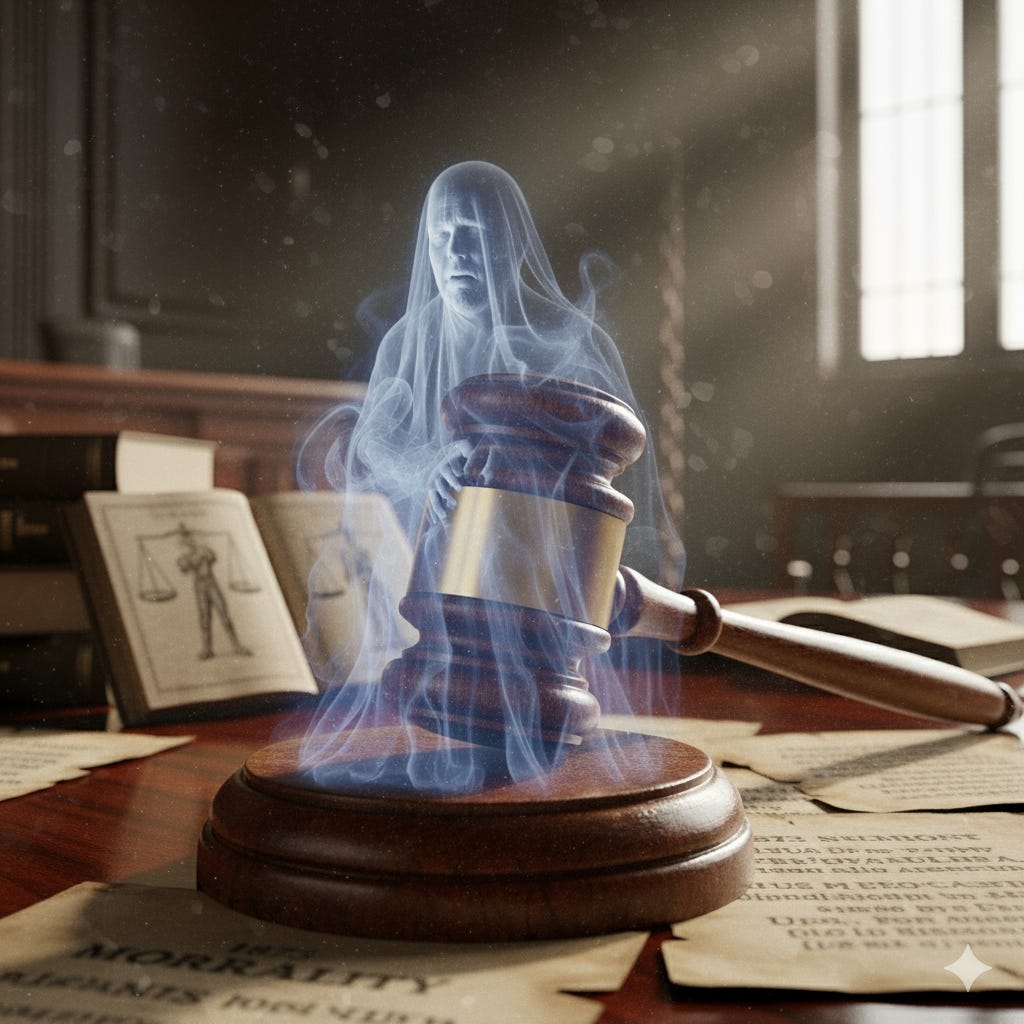
In a world where yesterday's liberties are today's felonies, a new moral panic is being weaponized, not through a public outcry, but through the silent, deliberate application of a forgotten law. The most intimate decisions of our lives are now being policed not by our neighbors, but by a 19th-century ghost and the cold, unfeeling arm of the state.
The blinding light of the Texas sun pierced through the thin blinds of her apartment, a brutal assault on her senses. Jessica groaned, her head a throbbing drumbeat of regret and residual bass. The remnants of last night's party clung to the air—the stale smell of spilled beer and the faint, bitter scent of something she couldn’t place. Flashes of the previous night flickered in her mind’s eye—a kaleidoscope of sweating bodies under strobing lights, the relentless thud of a bass line, the feel of a stranger's arm around her waist. A hand had appeared in her periphery, a sleek, dark glass pressed into her palm. "You're a star," a voice had said, close to her ear. She took a long, desperate gulp; the liquid was strangely bitter, not at all like the sugary cocktails she’d been drinking. The room had begun to spin faster then, and her last lucid memory was a cascade of laughter.
She fought her way back to the present, brewing a pot of strong, black coffee. As the machine hissed and sputtered, more memories surfaced—his face, handsome and overly familiar, his words slithering with practiced charm. She recalled the feel of his hands on her skin, the casual way he had unbuttoned her shirt as if it were a routine, and her own muffled assent that felt more like a distant hum than an active choice. She remembered the rush of cold air against her skin as he took her clothes off, a sense of detachment washing over her as if she were a spectator to her own body. The coffee burned her tongue, bringing her fully back to reality.
The days that followed blurred into a monotonous grind. The memories of the night faded into the background, a bad dream she'd successfully pushed down. But as the second week passed, a nagging feeling began to surface—a sense of imbalance, a dissonance in the rhythm of her body that she couldn't ignore. It was a subtle, insidious dread that something had been forgotten, something crucial. She checked her phone, her fingers trembling as she scrolled through the calendar app. Her period was late. Two weeks late. A cold dread, far worse than any hangover, settled deep in her gut.
She found the box under the sink, a small, white plastic thing that had been there for a year, a contingency she'd hoped never to need. With hands that shook uncontrollably, she took the test. A faint blue line appeared, then another. A positive. The word echoed in the silence of her apartment. She picked up her phone, calling her doctor’s office, but as the line connected, she hung up, her throat constricting. She then tried a clinic she had found online, but again, her courage failed her. It was a self-imposed prison of silence. She knew the reality: in her home state of Texas, abortion was banned. The legal landscape was a fractured mess of laws designed to make an impossible situation even more desperate. There was no one she could talk to, no clinic she could visit.
She went back to her phone, searching for options in a world that had seemingly decided her fate for her. She found a telehealth service, a doctor in Colorado who could ship the pills. It felt like a lifeline in a storm. On another day, a few weeks later, she sat at her computer, staring at a face on a screen. "The pills will arrive in three to five business days," the doctor’s voice was calm, reassuring. "Follow the instructions carefully. We'll be on call for you." The conversation ended, and for the first time in what felt like forever, she felt a flicker of hope.
The day of the package’s arrival, the weather was gray and oppressive, a perfect mirror for her own anxiety. The delivery notification pinged on her phone. The package was here, sitting on her doorstep, a small, brown box containing a secret that could save her or condemn her. As she opened her front door and reached for the box, a voice barked, "FREEZE! HANDS WHERE I CAN SEE THEM!" Two men in tactical vests, their faces grim, appeared from behind a parked utility van. One of them held up a warrant. "Jessica Reyes, you are under arrest for violating federal law. Specifically, the Comstock Act of 1873." The world seemed to stop spinning. The fragile hope she had dared to feel was shattered, replaced by the grim reality of handcuffs and the cold, hard stare of a world that had just decided her fate for her.
The legal battlefield over reproductive rights in a post-Dobbs America is not defined by new laws, but by a 19th-century ghost: the Comstock Act of 1873. Long considered an "unenforceable relic," this federal anti-obscenity law is being resurrected as a “backdoor” national abortion ban. Its revival is a calculated maneuver designed to circumvent the democratic process and bypass Congress. This strategy, outlined in blueprints like Project 2025 from the Heritage Foundation, aims to weaponize a long-dormant statute to impose a sweeping, nationwide restriction.
The law itself, officially titled “An Act for the Suppression of Trade in, and Circulation of, Obscene Literature and Articles of Immoral Use,” declared a wide range of materials “nonmailable”. Its key provisions, which still exist in the U.S. Code, prohibit the use of the postal service or other common carriers to convey “any article or thing designed or intended for the prevention of conception or procuring of abortion”. This wasn’t an act born of a desire to protect fetal life; it was a crusade rooted in Victorian morality, driven by a man named Anthony Comstock, a "champion of Victorian morality" who saw abortion and contraception as tools that enabled “illicit” sexual relations and threatened traditional institutions. He was an arch-purist who believed societal decay was directly linked to the availability of “obscene” literature and tools. His zeal and the political influence of a powerful special-interest group led to the passage of a broad federal law that reflected a specific moral agenda.
The Comstock Act was an immediate lightning rod for opposition. But for nearly a century, its power was gradually eroded by a series of legal challenges and a shifting judicial landscape. Activists like Margaret Sanger led a concerted effort to dismantle the law, culminating in cases that created a critical legal precedent: the Act's legality hinged on the sender's intent and whether materials were for a "lawful purpose". The 1936 case, United States v. One Package of Japanese Pessaries, established that the Act did not prohibit mailing contraceptives to a physician, thus marking a foundational shift in how the law was interpreted.
This erosion continued with landmark decisions like Griswold v. Connecticut (1965), which established a constitutional “right to privacy” that protected a married couple's right to use contraception. The subsequent decision in Eisenstadt v. Baird (1972) extended this right to unmarried individuals. These rulings effectively neutered the contraception-related provisions of Comstock-style laws nationwide. For nearly 50 years, the Comstock Act's abortion-related provisions were effectively dormant, shielded by the constitutional right to abortion recognized in Roe v. Wade.
Then came the seismic shift. The Supreme Court's 2022 decision in Dobbs v. Jackson Women's Health Organization eliminated the constitutional right to abortion, ushering in a new, fragmented legal landscape. In this void, anti-abortion advocates began their search for alternative legal avenues, and the Comstock Act, a "zombie law," re-emerged as a primary target. The strategy is brutally simple: use the law's "plain text" to impose a national ban on abortion medication, which accounts for over 60% of all abortions in the United States. This literalist interpretation argues that the statute is clear and unambiguous, ignoring over a century of judicial precedent.
The legal showdown has already begun. Texas Attorney General Ken Paxton has explicitly cited the "federal Comstock Act" in cease-and-desist letters to organizations shipping abortion pills. The most significant case to date, Alliance for Hippocratic Medicine v. U.S. Food and Drug Administration, saw plaintiffs argue that the FDA's approval of mifepristone was unlawful because the Comstock Act "prohibits the use of postal 'mails' to convey or deliver chemical abortion drugs". A federal district judge in Texas embraced this literalist view, finding that the "plain text of the Comstock Act banned mailing chemical abortion drugs".
While the Supreme Court ultimately sidestepped a direct ruling on the Comstock Act by deciding the plaintiffs lacked standing, the battle is far from over. Comments from Justices Alito and Thomas during oral arguments—with Justice Alito noting that the Comstock Act is "not some obscure subsection of a complicated, obscure law"—suggest that the Court may be receptive to a literalist interpretation in a future case where standing is not an issue.
The consequences of a literalist interpretation would be catastrophic. It would override state laws and constitutional amendments that protect abortion rights, reversing the very principle of state authority that the Dobbs decision was ostensibly based on. It would effectively cut off access to medication abortion for millions of Americans and have a "chilling effect" on healthcare providers, who could face criminal penalties for providing routine care for miscarriages and other severe pregnancy complications. It is an elegant, cynical strategy: to use a law intended to police morality to dismantle a healthcare system, all without a single vote from the people. In a world where the past keeps coming back to haunt us, the Comstock Act is the definitive proof that some ghosts never rest.
Tensor_Insurgent concluded:
*****The consequences of a literalist interpretation [of the Comstock Act] would be catastrophic. It would override state laws and constitutional amendments that protect abortion rights, reversing the very principle of state authority that the Dobbs decision was ostensibly based on. It would effectively cut off access to medication abortion for millions of Americans and have a "chilling effect" on healthcare providers, who could face criminal penalties for providing routine care for miscarriages and other severe pregnancy complications. It is an elegant, cynical strategy: to use a law intended to police morality to dismantle a healthcare system, all without a single vote from the people. In a world where the past keeps coming back to haunt us, the Comstock Act is the definitive proof that some ghosts never rest.*****
.
It is vital to clarify that while the original Comstock Act was limited to the U.S. Postal service, more recent federal law has broadened the scope to also encompass delivery services, such as FedEx and UPS.
.
https://www.kff.org/womens-health-policy/the-comstock-act-implications-for-abortion-care-nationwide/
*****In 1873 – at the behest of anti-vice crusader, Anthony Comstock – Congress enacted a law banning the interstate mailing and receiving of “obscene, lewd, or lascivious” writings, or “any article or thing designed or intended for the prevention of conception or procuring an abortion.” In 1909, Congress enacted a similar law banning the use of express company or common carrier (such as FedEx or UPS) to mail “any drug, medicine, article, or thing designed, adapted, or intended for preventing conception or producing abortion, or for any indecent or immoral use.” These laws came to be known collectively as the Comstock Act.*****